
FAQs about the Expansion
The Planning Proposal
- Asphalt Plant
- Cement Plant
- Concrete Plant
- Fertilizer manufacture and storage
- Lumber Mill
- Petroleum Refinery
- Pulp Mill
- Paper Mill
- Recycling Facility - including metal shredding
- Scrap or Salvage Yard;
- Nuclear power generation.
A setback is a required distance between a structure (like a house or building) and a property line, road, or other feature.
It's mainly about building regulation—to ensure safety, privacy, sunlight, and aesthetic consistency.
Example: the Spruce Lake Industrial (SLI) Zone proposes that an industrial building constructed in that new zone must be setback a minimum of 250 metres from the nearest residential property line, the same distance as 2 and a half international regulation size soccer fields. Everywhere else in the City that setback would typically be 30 metres, or about 6 big cars lined up end to end.
A buffer is a space or zone that separates two different uses (like a residential area and a highway) or protects sensitive areas (like wetlands or streams).
It typically includes vegetation or natural features to reduce noise or visual impact
Example: The City is proposing a 150 metre wide treed / vegetative buffer all along Lorneville road to create a physical natural barrier between homes and industry.
Is the City creating a Heavy Industrial Park in Lorneville?
No, the City is not creating a Heavy Industrial Park in Lorneville. However this belief likely stems from the fact that it is very common to confuse land use planning terms: Designation and Zone.
The Municipal Plan (PlanSJ) establishes designations, which generally steers land use development to their most appropriate locations in the City. The Municipal Plan is a policy document that addresses where residential, commercial, and industrial areas can generally be located now and in the future.
PlanSJ has many designations, but it generally uses a single designation (Heavy Industrial) for every industrial park in the City. At the heaviest end, this designation can allow an Oil Refinery, or a Pulp Mill. At the lightest end it could allow a self storage facility or a vehicle body shop.
The average person would not consider a self storage facility to be HEAVY INDUSTRY. This is where Zoning helps clarify what is actually permitted in an area that is designated a certain way under the Municipal Plan, and is the first hint, that just because the designation of an area is Heavy Industrial, it does not mean that it results in an Industrial Park full of smokestacks.
The existing Spruce Lake Industrial Park is already designated as Heavy Industrial, and the proposed expansion of the industrial park will also be designated Heavy Industrial under the Municipal Plan, but it is not a Heavy Industrial Park - and further answers in this FAQ will help clarify why and what that means.
What is Zoning, and how it is different from the Municipal Plan?
Zoning is a system where land is divided into zones and each of those zones has a series of regulations that determine what properties can and cannot be used for within that zone.
Zones provide clear specifications that govern the uses and the buildings in that zone, such as height, distance from other nearby buildings or the road, and the size and scale of buildings, etc.
Saint John has a wide variety of zones, such as residential zones, commercial zones or industrial zones, etc. and each of those categories can be refined further. These zones are defined in the City's Zoning By-Law which is a completely different document than Plan SJ.
Zones are established to help avoid conflicting uses – you wouldn’t want to build a large shopping mall (Commercial Use) in a small suburban subdivision (Residential Zone), or a school (Community Use) in the middle of an industrial park.
Zones also provide clear instructions about what is or is not permitted in that Zone called Permitted Uses, whether something is permitted only if it meets a stringent requirement called Conditions of Use, and what specific requirements there may be in that zone for where a building can be located, its size, height, etc., also called Zone Standards.
To Illustrate:
A Bar or Nightclub is a permitted use in the City's Corridor Commercial (CC) Zone - so generally speaking a developer can construct a bar in that zone. As reference, almost all of Rothesay Avenue is zoned CC. Does that mean it can go anywhere in that zone? No, there is a specific Condition of Use for Bars and Nightclubs in the (CC) Zone:
A lot containing a Bar, Lounge, or Nightclub shall not be located within 60 metres of a Residential zone.
This means that a bar or Nightclub can't just go anywhere in a zone that allows for that use as there is a condition of use that it can't be located too close to houses, such as the neighbourhood of Glen Falls.
To further illustrate, imagine this same bar is located 100m away from the nearest house, it can't simple build to whatever scale it wants, it must abide by the Zone Standards as well.
Imagine a developer from Los Vegas comes to Saint John and wants to build a massive nightclub that is 10 storeys tall (30 to 40 metres in height). If they wanted to build in the CC Zone 100m away from residents, they still couldn't build it that tall, because maximum height for buildings is capped in that CC zone at 15 metres.
Simply put, the Municipal Plan provides overall strategic vision for the City, and zoning provides specific regulations to achieve that vision.
The City of Saint John Zoning By-Law can he accessed here
An interactive map of all the City's existing Zones can be accessed here.
What Zone is proposed for the Industrial Park, and how is it different from "Heavy Industry"?
If the City intended for the the expanded Spruce Lake Industrial Park to be a 'Heavy Industrial Park' it would have zoned the whole park as Heavy Industrial (IH) which is the same zoning that permits the Heavy Industry that well known in Saint John e.g. the Refinery, the Pulp Mill, Canaport LNG, the Papermill, etc.
This is where the confusion stems, for each of those instances the lands they are on are designated Heavy Industrial, and they are also zoned Heavy Industrial (IH).
Most of the existing Spruce Lake Industrial Park is designated Heavy Industrial and zoned Medium Industrial (IM). Generally speaking a medium industrial zone, does not allow any type of nuisance to extend beyond the property boundaries.
A new type of Industrial Zone is being proposed for the expanded Spruce Lake Industrial Park that is primarily focused on Light and Medium industrial uses. This new zone is called Spruce Lake Industrial (SLI) Zone.
A broad discussion of the zone can be found in the Staff Report beginning on page 23.
The Zone is prohibiting a wide variety of things that are synonymous with 'Heavy':
Prohibiting the Discharge of Air Pollution - i.e. no smoke stacks.
Prohibiting specific uses, that are already present in Saint John and often associated with the term 'heavy industry' such as:
This means for example, that even if a specific use isn't listed as 'prohibited', such as an iron smelter, it doesn't need to be explicitly listed as permitted because it would discharge air pollution, and discharging air pollution in this zone is not permitted.
This zone also has the most stringent setbacks for an industrial park in the province of New Brunswick to ensure there is clear separation between existing residents in Lorneville and the proposed industrial park expansion.
In summary, this new area will be designated Heavy Industrial but it will be zoned Spruce Lake Industrial (SLI) Zone.
What is a setback and what is a buffer?
.
Setback:
Buffer:
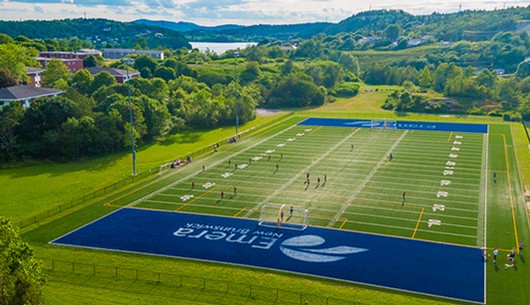
For a sense of scale, the Emera Field at Shamrock Park is 150 metres long from the fence at one endzone to the fence past the opposite endzone.
To see the proposed setbacks and buffers proposed for the new zone see the new setback map or the map that defines natural buffers ( i.e. park and natural areas)
To read a full description and discussion of the proposed setbacks see the Staff report beginning on page 33.
How do the proposed setbacks compare to other parts of the City?
.
Here are examples of current setbacks elsewhere in the City, and what those setbacks would be if the a similar building was created in the proposed Spruce Lake Industrial Zone.
| Type of Use | Examples | Minimum setback to residential property in all other areas of Saint John | Spruce Lake Industrial Zone - Minimum setback to residential property proposed in Lorneville |
| Business Office | A Union office | 7.5 metres | 150 metres |
| Commercial Use | Gas Station | 30 metres | 150 metres |
| Light Industrial Use | Car Wash | 15 metres | 250 metres |
| Medium Industrial Use | Warehouse Facility | 15 metres | 250 metres |
| Heavy Industrial Use - Non Volatile* | Industrial Service & Repair | 30 metres | 250 metres |
| Heavy Industrial Use - Volatile** | Bulk Fuel Storage Depot | 150 metres | 500 metres |
| Electrical Generation Station*** | Bayside Natural Generating Gas | 150 metres | 1000m |
* The proposed expanded Spruce Lake Industrial Park is primarily intended for light, medium and commercial uses. If there is a proposed large development that is non-emitting, safe, and risks can be mitigated or eliminated, such as a large microchip facility, it could be permitted provided it was constructed 250 metres or more away from residences and was otherwise permitted in the zone.
** A Volatile use is where the type of material used, produced, or stored and or the type of manufacturing process involved may be harmful or detrimental to a person’s health and or property.
To follow the prior example if that same clean microchip factory used a certain volume of acids in the making of semi-conductors, as long as that risk can be mitigated via engineered solutions, that portion of the manufacturing process could be permitted, as long as it was 500m away or more from the nearest residence and met all other conditions of the zone.
*** The City is not permitting emissions in this new park, with one theoretical exception. If NB Power cannot meet the power demands for the new park and needs an onsite solution, the City would permit a small <300MW natural gas generating station to be located within the park (if strictly needed) provided it had low emissions and was a minimum of 1km away from the nearest residence.
Why can't this industrial park be located elsewhere?
The City and the Saint John Industrial Parks commissioned a study by Deloitte in 2023 to examine possible locations for a new industrial park in the City limits. There are very few alternatives locations within the City Limits, and none aside from Lorneville that are currently economically feasible due to very significant challenges involved in acquiring land, and then very significant costs in running power, water, and road infrastructure to those areas.
The current inventory of City owned industrial lands is included in Appendix 2 of the Staff report relating to the Lorneville Community Liaison Committee
Saint John Industrial Parks, owns less than 52 Hectares of land in total in the Spruce Lake industrial Park. These lands are spread out across the park with an average lot size of 5 hectares. Saint John Industrial Parks owns less than 19 Hectares of land in the McAllister Industrial Park, and it is also spread out across the park with an average lot size of 2 hectares.
Due to the spread-out nature of these lands, it presents no opportunity for any significant land assembly to attract larger development opportunities.
There are several large development projects that would require lot sizes of 15 to 55 hectares each and the City has no capacity to welcome such development opportunities in Saint John with the existing inventory of Industrial Zones lands as they currently stand.
If Saint John wishes to have all the positive benefits of a new, clean and modern industrial park, such as new local jobs, new businesses that buy or use services of existing businesses in the region, and new taxes to pay for improved services for all residents, the park must be located in Saint John and not elsewhere in New Brunswick.
Protecting residents and the environment
- Avoid impacts to the wetland at the planning stage;
- Minimize impacts (e.g., require applicable environmental protection measures during permitted alteration etc.;
- Compensate for impacts that cannot be avoided or minimized.
- Particulate Matter (PM)
- Ground-level ozone (O3)
- Nitrogen dioxide (NO2)
- Sulphur dioxide (SO2)
- Volatile Organic Compounds (VOCs)
What is being done to protect the environment in Lorneville?
An Environmental Impact Assessment (EIA) was submitted to the Provincial Government on June 11, 2024.
An Environmental Impact Assessment (EIA) is a process through which the environmental impacts potentially resulting from a proposed project are identified and assessed early in the planning process. EIA identifies steps that can be taken to avoid negative environmental impacts or reduce them to acceptable levels before they occur. EIA therefore, represents a proactive, preventative approach to environmental management and protection. EIAs consider impacts to trees, wetlands, other flora and fauna, residents, water, drinking water, first nations, and a wide variety of other considerations. All materials submitted by the applicant are reviewed by an independent Technical Review Committee composed of subject matter experts in their related fields and they may require additional information from the applicant.
The City is also prohibiting air pollution in the industrial park, and will add additional groundwater monitoring wells to the area.
The EIA process can also impose conditions on the applicant to avoid, or reduce specific impacts, and the City would abide by any such conditions imposed by this independent process.
What is being done to protect wetlands?
Contrary to some misinformation shared on social media, there has never been any intention of impacting the coastal estuaries in Lorneville, also called Provincially Signficant Wetlands (PSW) as a result of the Spruce Lake industrial park expansion. They have special status and will remain off limits to development, and the City is doubling the required provincial buffer of 30 metres around the Provincially significant wetlands so that no development ever occurs near these sensitive ecosystems.
These PSWs are different than forest wetlands which do not have special status and compose the majority of wetland in Saint John, including Lorneville.
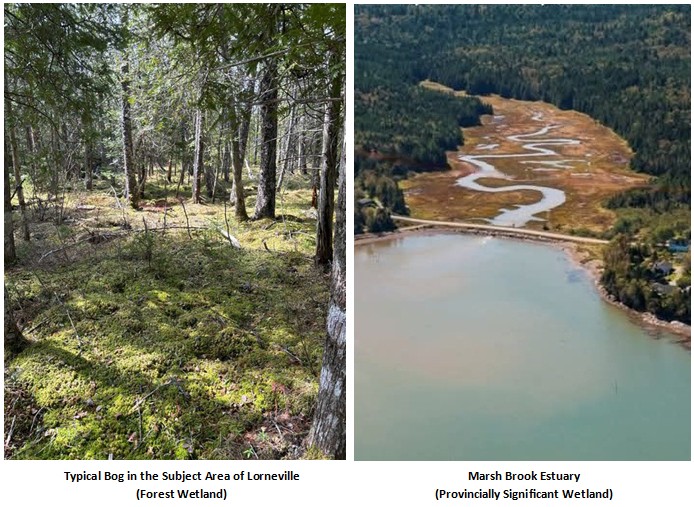
The Province has established clear guidelines on developing on or near wetlands. Development on PSWs generally must be avoided, but other types of wetland, including forested wetlands can be developed on, provided there will be no net loss of wetland function. The Environmental Impact Process follows a three step mitigation process for mitigating development on or near wetlands:
Any non provincially significant wetlands that would need to be removed to allow for the expansion of the industrial park would be compensated at a minimum of a 2:1 ratio, following provincial guidance and requirements.
Example of a wetland compensation project
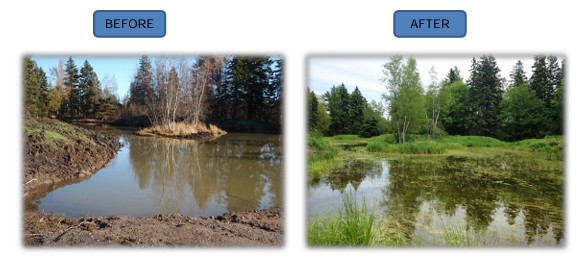
For more information on wetland compensation, see these helpful provincial guidelines.
Will this generate lots of air pollution and traffic?
Air Pollution
The City is prohibiting the discharge of Air Pollution from buildings in this new industrial park - i.e. no smoke stacks
Traffic
The Industrial Park tenants would use King William Road as their primary access route. This road currently uses only 3% of its capacity and has ample room to accommodate the industrial park expansion. As specific new developments come to the park, additional traffic studies would be completed that would identify when or if adding one or more lanes to the roadway would be required to accommodate any increases in traffic volume.
How will the risks be addressed?
Risks are being addressed through a variety of means.
1) The Environmental Impact Assessment (EIA) process can impose requirements that an applicant avoid, or reduce specific risks to the environment.
2) The City is implementing very large setbacks in the industrial park (described elsewhere in this FAQ) to create lots of distance between the proposed industrial park expansion and existing residential areas.
3) The City has existing By-Laws that ensure all developments adhere to the National building code and all other relevant by-laws that protect residents and other neighbouring properties.
4) The City has a drainage by-law to protect against run off, and it is also imposing a groundwater monitoring program.
5) The City is imposing a new requirement that industrial buildings that present any type of risk to the community or the environment, would need to have a risk assessment completed by a professional that avoids the risks or mitigates against them by approved engineered solutions.
6) Buildings in the industrial park will need to be connected to the City's sewer system and on-site septic systems will not be permitted.